
Introduction
Mojo is quickly becoming one of the most exciting programming languages for AI and high-performance computing. Moreover, it is a powerful new programming language. It mixes Python’s ease with C’s speed. This makes it perfect for AI and fast computing tasks. Want to learn how to use it well? Keep reading!
Furthermore, this guide will show you the basics and advanced tips. We’ll also answer common questions. Let’s get started!
Why Use Mojo?
It stands out for three big reasons:
- It’s super fast – Firstly, runs as quickly as C++ code
- Works with Python – Secondly, uses all your favorite Python tools
- Great for AI – Then, built for machine learning tasks
Now, let’s learn how to use it.
Getting Started
1. Install Mojo
Firstly, you need to install it. Here’s how:
- Firstly, go to Modular’s website
- Secondly, sign up for an account
- Thirdly, download the tools
- Then, check it works by typing
mojo --version
2. Your First Mojo Program
Secondly, Let’s write a simple program. Open a file called hello. and type:
Then, copy
Then, download
fn main():
    print("Hello, Mojo!")
Run it with:
bash
Then, copy
Then, download
mojo hello.mojo
Moreover, you’ll see “Hello,” it appear. Easy, right?
Top Tips for Better Code
1. Use Clear Types
Firstly, tell it what types you’re using for extra speed:
Then, Copy
Furthermore, Download
fn add(a: Int, b: Int) -> Int:
    return a + b
This helps it run your code faster.
2. Do Multiple Things at Once
Secondly, it can do many calculations together:
Then, Copy
Furthermore, download
from parallel import parallelize

fn fast_add(numbers):
    parallelize[threads=4](lambda i: numbers[i] * 2)
This makes big jobs finish quicker.
3. Manage Memory Well
Thirdly, lets you control memory when needed:
Then, Copy
Moreover, download
fn make_space(size: Int):
    let space = Pointer[Int].alloc(size)
    # Remember to free this later!
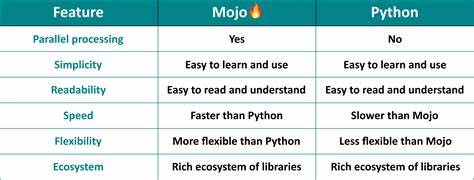
Mojo vs Python: Quick Comparison
| Feature | Mojo | Python |
|---|---|---|
| Speed | Very fast | Slower |
| Typing | Optional clear types | Always flexible types |
| Best For | Heavy numbers of work | General coding |
Handy Mojo Tricks
1. Write Code That Writes Code
Firstly, use @parameter for smart coding:
Then, copy
Moreover, download
@parameter
fn double[n: Int]() -> Int:
    return n * 2

print(double[5]())  # Prints 10
2. Crunch Numbers Faster
Secondly, process many numbers at once:
Then, copy
Then, download
from algorithm import vectorize

fn quick_maths(a: Tensor):
    vectorize[4](lambda i: a[i] * 2)
Common Questions
Q: Will it replace Python?
A: No, it works with Python to make fast parts faster.
Q: Can I use NumPy in it?
A: Yes! Just import it like in Python.
Q: How much faster is it?
A: Some tests show 35,000 times faster!
Q: Is it free to use?
A: For now, yes. It might become open-source later.
Q: What’s it best for?
A: AI work, scientific computing, and speed-critical apps.
If you want to read Web 3.0 Click Here
Final Tips
- Firstly, start with small programs
- Secondly, add types to speed things up
- Thirdly, use parallel processing for big jobs
- Then, mix it with Python for the best results
Ready to try it? Install it today and see how fast you can go!