
Introduction: From Chaos to Clarity
Kanban Do you ever feel like your work is a chaotic whirlwind of tasks, deadlines, and constant interruptions? You’re not alone. Many of us struggle to visualize our workload, leading to stress, missed deadlines, and that nagging feeling that we’re always busy but never truly productive.
What if you could see all your work in one place, instantly identify bottlenecks, and focus on what truly matters? You can. The solution isn’t a complex new software or a rigid, overwhelming framework. It’s a simple, powerful method called Kanban.
Initially developed by Toyota engineer Taiichi Ohno to improve manufacturing efficiency, Kanban has evolved into a brilliant tool for knowledge workers, teams, and even individuals managing their personal lives. Additionally, at its heart, Kanban is about flow, visualization, and continuous improvement. It doesn’t demand a dramatic overhaul of your process; instead, it meets you where you are and helps you get better, one step at a time.
This guide will walk you through everything you need to know to start using Kanban effectively. We will break down its core principles, show you how to build your first board, and share advanced strategies to supercharge your productivity.
The Foundation: Core Principles of Kanban
Before you start moving digital sticky notes around, it’s crucial to understand the philosophy behind Kanban. These four principles are your compass.
If you want to read about Inkscape, click here.
1. Start with What You Do Now
Unlike other methodologies, Kanban doesn’t require you to scrap your current process. Instead, you visualize it. Moreover, this respectful approach minimizes resistance and allows you to identify real areas for improvement without assigning blame.
2. Agree to Pursue Incremental, Evolutionary Change
Kanban avoids massive, disruptive shifts. Why? Because big changes often frighten teams and fail. Instead, Kanban encourages small, continuous tweaks. This evolutionary approach ensures stability while steadily driving progress.
3. Respect Current Roles and Responsibilities
Kanban recognizes that people have existing skills and roles. It doesn’t mandate a new hierarchy. By respecting the current structure, it gains broader acceptance and leverages existing strengths to facilitate change.
4. Encourage Leadership at All Levels
Additionally, improvement isn’t just a manager’s job. Kanban empowers everyone on the team to identify problems, suggest solutions, and experiment. Moreover, this creates a culture of shared responsibility and continuous learning, where the best ideas can come from anywhere.
Kanban Putting Theory into Practice: The Six Core Practices
Moreover, these principles are brought to life through six essential practices. Think of these as the rules of the road for your Kanban system.
1. Visualize Your Workflow
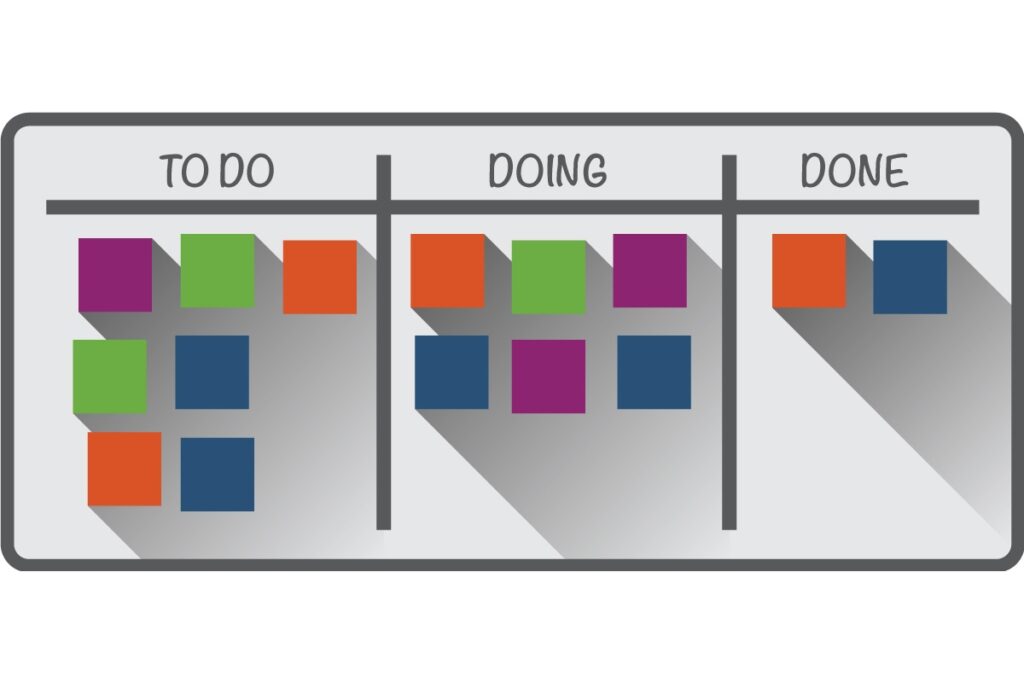
Firstly, this is the most famous aspect of Kanban. You make your work visible, typically on a “Kanban board.” This board is divided into columns, each representing a stage in your workflow (e.g., “To Do,” “In Progress,” “Done”). Then, each task is written on a card and moves from left to right as it progresses. Suddenly, your abstract to-do list becomes a concrete, shared visual.
2. Limit Work in Progress (WIP)
Secondly, this is the secret sauce of Kanban. How often have you started five tasks but finished none? Multitasking is a myth; it fractures focus and slows you down. By setting strict limits on how many tasks can be in any “In Progress” column at once, Kanban forces you to focus. Then, you must finish a task before starting a new one. This single practice dramatically reduces context-switching, accelerates completion times, and exposes bottlenecks.
3. Actively Manage Flow
Thirdly, you don’t just move cards; you observe how they move. Is work flowing smoothly through your system, or is it getting stuck in a specific column? Managing flow means actively monitoring the movement of tasks and optimizing your process to make that flow as smooth, fast, and predictable as possible.
4. Make Process Policies Explicit
Fourthly, how does a task get from “To Do” to “In Progress”? What are the specific criteria for a task to be considered “Done”? If these rules are vague, your process will be too. Then, Kanban demands that you define and make these policies clear and visible to everyone. This eliminates confusion and ensures a consistent standard of quality.
5. Implement Feedback Loops
Fifthly, continuous improvement requires regular feedback. Kanban teams implement structured feedback loops through daily stand-up meetings, weekly delivery reviews, and operations reviews. Then these meetings are focused on the board itself, fostering data-driven conversations about what’s working and what isn’t.
6. Improve Collaboratively and Evolve Experimentally
Using insights from feedback loops and flow data, the team collaboratively suggests small, experimental changes to improve. Then, the keyword is experimental. You try a change, measure its impact, and decide whether to adopt, adapt, or abandon it. This scientific approach removes the emotion from process improvement.
Your Hands-On Guide: Building a Kanban Board
Let’s translate theory into practice. You can create a physical board using a whiteboard and sticky notes, or a digital one with tools like Trello, Jira, Asana, or Monday.com.
Step 1: Map Your Core Workflow
Identify the key stages a task goes through from conception to completion. A simple starting point is:
- Backlog: Firstly, Everything that needs to be done someday.
- To Do: Work that is ready to be pulled in now.
- In Progress: Work that is actively being worked on.
- Review/QA: Work that is completed but needs testing or approval.
- Done: Work that is 100% complete and delivered.
Step 2: Create and Populate Task Cards
Each task, user story, or action item is represented as a card. Then, write a clear, concise title and include essential details like a description, due date, assignee, or tags. Don’t overcomplicate it at first.
Step 3: Set Your Work-in-Progress (WIP) Limits
This is critical. For each active column (especially “In Progress” and “Review”), set a maximum number of cards allowed. Then, a good starting limit is equal to the number of people on your team plus one. For a team of 4, a WIP limit of 5 for “In Progress” is a solid start. Enforce this ruthlessly.
Step 4: Execute and Refine Your Process
Now, use the board for your daily work.
- To start a new task, pull a card from the “To Do” column into “In Progress”—but only if the WIP limit allows it.
- When you finish the task, move it to the next column.
- Your daily stand-up meeting is now held in front of the board. Then, discuss the flow of cards, not just a list of activities.
Mastering the System: Advanced Kanban Metrics
As you mature, use data to guide your improvements.
- Cycle Time: The average time it takes for a card to move from “To Do” to “Done.” Your goal is to reduce this.
- Throughput: The number of tasks completed in a given time (e.g., per week). Your goal is to increase this steadily and predictably.
- Cumulative Flow Diagram (CFD): A powerful chart that shows the number of cards in each state over time. Then, it helps you visualize bottlenecks (where bands widen) and predict future performance.
Frequently Asked Questions (FAQ)
Is Kanban only for software development teams?
Not! While it’s popular in tech, its principles are universal. Marketing teams, HR departments, event planners, writers, and even individuals managing home projects can use Kanban to bring clarity and flow to their work.
What’s the main difference between Kanban and Scrum?
Scrum is a prescriptive framework with fixed-length sprints, defined roles (Scrum Master, Product Owner), and a goal of delivering a set batch of work. Kanban is a fluid method focused on continuous flow with no required roles or fixed timeboxes. Then, Scrum is like a train with a set schedule; Kanban is like a traffic light system that manages the continuous flow of cars. Many teams even blend them into “Scrumban.”
How do I convince my team to try Kanban?
Focus on its lightweight, non-disruptive nature. Pitch it as a simple way to “see our work” and reduce the stress of multitasking. Start with a pilot project for a few weeks and use the visible results (e.g., “We completed 20% more tasks!”) as proof.
What if we break a WIP limit?
It happens! Don’t see it as a failure, but as a valuable signal. It’s a clear indicator that your system is under strain. Stop and have a conversation. Why did it happen? Was there a blocker? An emergency? An unrealistic expectation? Then, use it as a learning opportunity to improve your process or adjust your limits.
Can I use Kanban for personal task management?
Yes, it’s incredibly effective! A simple personal board with “To Do,” “Doing,” and “Done” can revolutionize your focus. Then, limiting your “Doing” column to 1-3 tasks forces you to concentrate and creates a wonderful feeling of accomplishment as you move items to “Done.”
Conclusion: Your Journey to Flow Begins Now
Kanban is more than a project management tool; it’s a lens through which you can view your work. It replaces chaos with clarity, busyness with purpose, and stagnation with continuous growth. It teaches you to stop starting and start finishing.
The beauty of Kanban is that you can start today. You don’t need permission or an expensive software subscription. Grab a whiteboard, some sticky notes, and your team. Then, map your current process, visualize your work, and commit to limiting your work in progress. Embrace the small, evolutionary changes. Observe the flow.
Your path to a more productive, less stressful, and more predictable workflow is waiting. All you have to do is take the first step and visualize it.